The Unpaid Trap: Which Industries Still Expect You to Work for Free?
If you are a college student navigating the internship market right now, you have probably felt the anxiety. You scroll through listings, find a "dream role" at a prestigious company or a crucial stepping stone in your field, and then you see the fine print: Unpaid.
At IntHunt, we decided to stop guessing and start counting. We analyzed thousands of internship roles to separate the "Safe Zones" from the "Traps." We looked at the ratio of Paid vs. Unpaid roles across fields of study, organization types, and internship categories.
The data confirms what many students have long suspected: The internship market is split in two. In one world, talent is compensated aggressively. In the other, "experience" is still used as a currency to pay the bills.
Here is the statistical reality of who pays, who doesn't, and which industries are the riskiest for your bank account.
The Danger Zones: "Passion" Industries Come at a Price
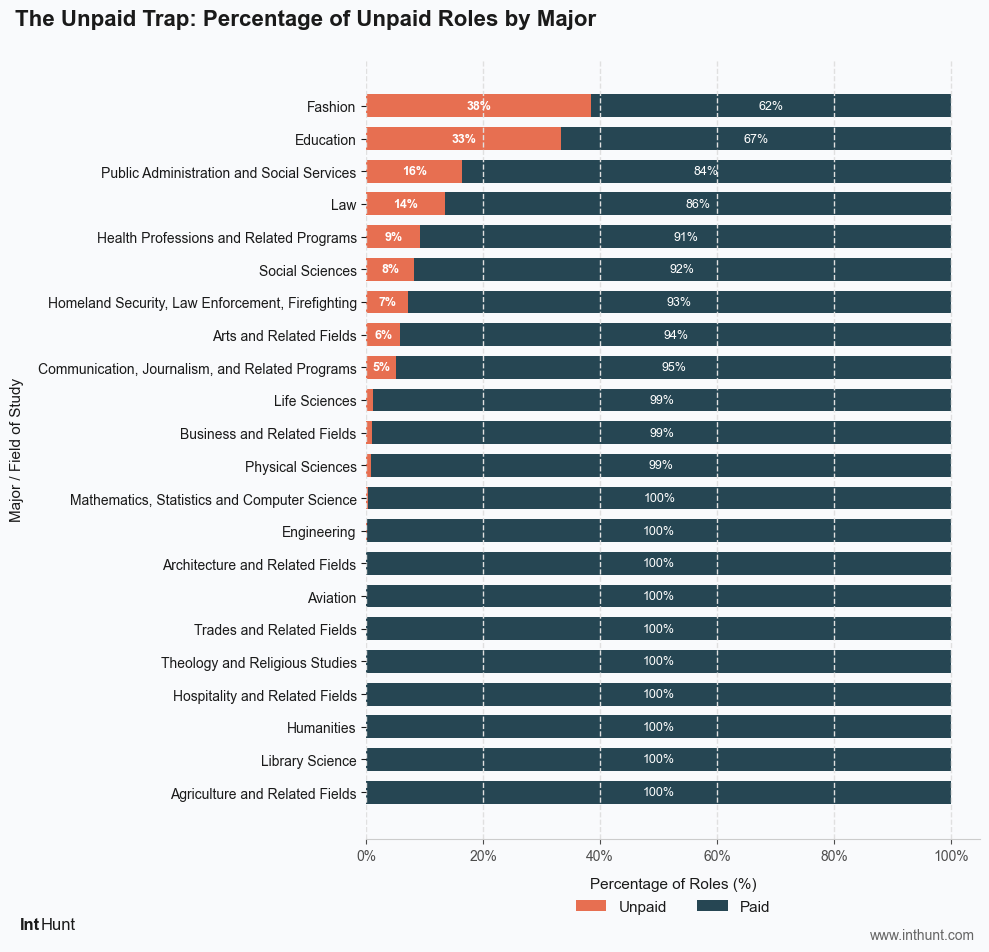
The data reveals a harsh correlation: the more "glamorous," creative, or altruistic the field, the less likely you are to see a paycheck. Industries that rely on passion often exploit it. As seen in the chart below, the disparity between fields of study is massive.
1. Fashion (The Highest Risk)
If you are studying Fashion, you are entering the most statistically dangerous territory for unpaid labor.
- 38% of all roles targeting Fashion majors are unpaid.
- 62% are paid.
This is the classic "Devil Wears Prada" syndrome. Because the allure of the industry is so high and the competition for spots is fierce, companies know they can offer 0% salary and still receive hundreds of resumes. They are banking on the fact that you need the name on your resume more than they need to pay you.
2. Education
Education majors face a similar, albeit different, trap.
- 33% of roles targeting Education majors are unpaid.
This is often framed as "student teaching" or mandatory practicum hours, but the result is the same: a massive sector of the workforce is being trained on zero wages.
3. Public Administration & Law
While better than fashion, these fields are still statistically significant offenders.
- 16% of roles for Public Administration majors are unpaid.
- 14% of roles for Law majors are unpaid.
This is particularly shocking given that law students are studying the very regulations that often prohibit unpaid labor. However, government and judicial internships frequently rely on the prestige of the judge or the agency to justify the lack of compensation.
The Safe Zones: Where Unpaid Work is a Red Flag
On the other side of the spectrum, we have the quantitative and technical fields. In these industries, supply and demand are working in the student's favor. If you are in these majors, an unpaid internship isn't just "unlucky"—it’s a statistical anomaly and a massive red flag.
Business, Tech, and Engineering
The data here is stark. The unpaid rate drops to near zero.
- Business and Related Fields: Only 1% Unpaid.
- Physical Sciences: Only 1% Unpaid.
- Engineering: Approximately 0% Unpaid.
- Computer Science: 0% Unpaid.
If you are a Computer Science or Engineering major and a recruiter asks you to work for free "for the equity" or "for the portfolio," run. The market standard is 100% paid. You have leverage; use it.
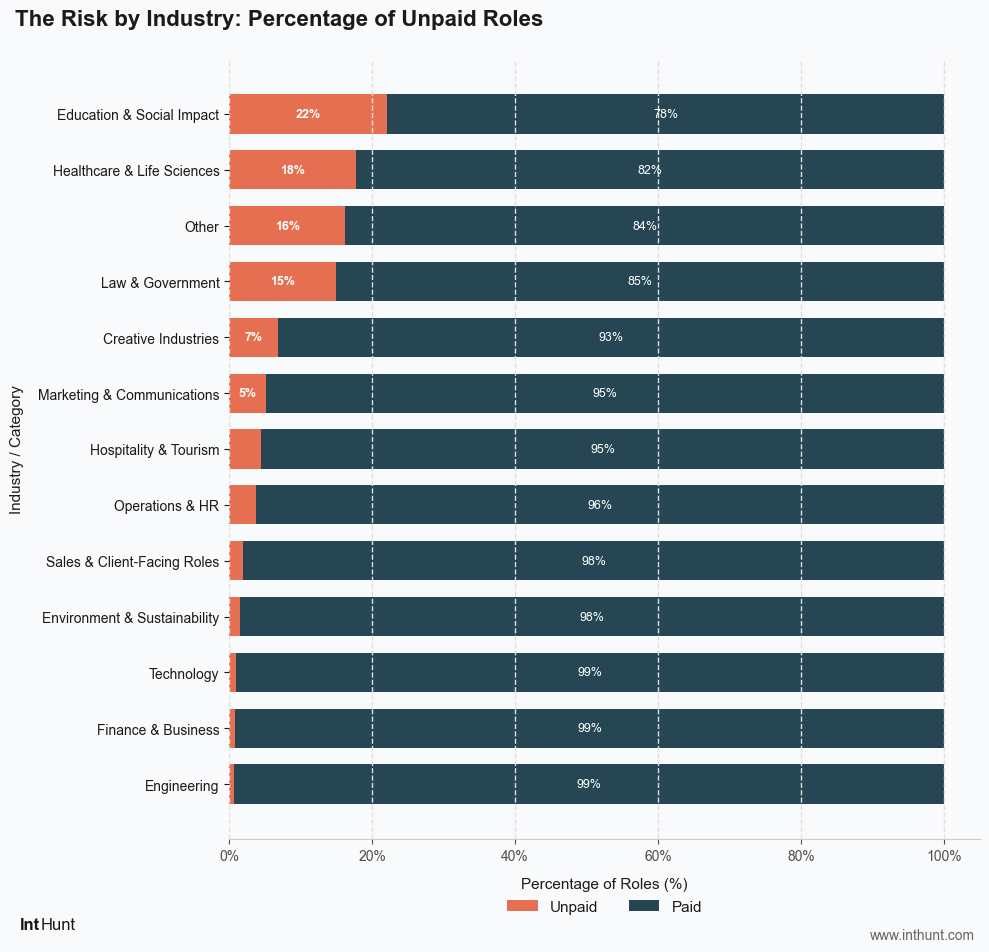
When we look at the data differently—by the category of the internship role rather than just the major—we see similar trends reinforcing these safe and danger zones.
The Shocking Truth About Organization Types
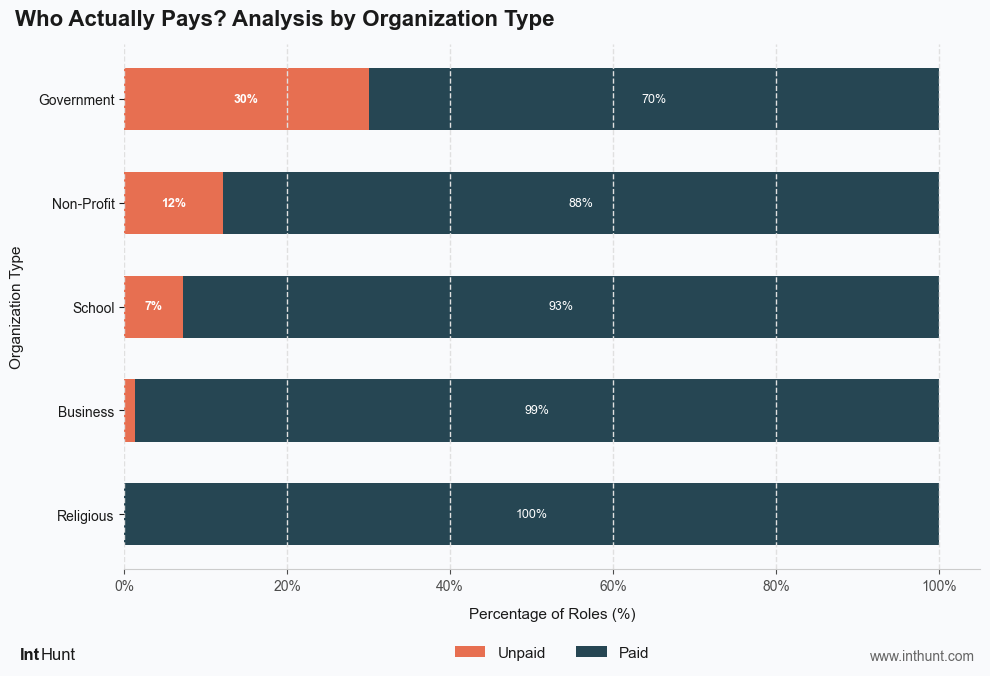
When we break the data down by Organization Type, a surprising narrative emerges regarding who is actually doing the exploiting.
We generally assume that massive corporations are the greedy ones and public service sectors are the "good guys." The data suggests otherwise when it comes to early-career compensation.
Government vs. Business
- Government: 30% of roles are Unpaid.
- Business: Only 1% of roles are Unpaid.
You read that right. The Government sector is 30x more likely to ask you to work for free than the private business sector. While private businesses face strict scrutiny under labor laws, government agencies often utilize budget constraints and "civic duty" frameworks to justify unpaid positions.
The Non-Profit Reality
- Non-Profit: 12% of roles are Unpaid.
While higher than the business sector, Non-profits are actually better about paying interns than the Government. Despite operating on donations and tight margins, the majority (88%) of non-profit roles in our dataset were paid positions.
Unpaid Internships Legality Statistics: What You Need to Know
If you are staring at an unpaid offer right now, you are probably Googling "unpaid internships legality statistics." Here is the short version of where the law stands.
In the United States, for-profit employers generally must pay interns unless they pass the "Primary Beneficiary Test" established by the courts. This test examines seven factors to determine who benefits more from the arrangement: the employer or the intern.
Key factors include:
- The internship provides training similar to an educational environment.
- The internship is tied to the intern's formal education (academic credit).
- The intern’s work complements, rather than displaces, the work of paid employees.
The "For-Profit" Red Flag
Given that our data shows 99% of Business roles and 100% of Engineering roles are paid, any for-profit company in these sectors claiming they "don't have to pay you" because it's a "learning experience" is likely violating labor standards. They are betting you won't report them.
In Creative and Fashion industries (38% unpaid), the lines are often blurred intentionally. But remember: if you are doing grunt work that a paid employee would otherwise do, you legally deserve a paycheck.
The Verdict: Don't Get Trapped
The landscape of internships is changing, but the trap remains for specific majors. If you are in Fashion, Education, or seeking Government roles, you need to be hyper-vigilant. The statistical likelihood of being asked to work for free is high, but that doesn't mean you have to accept it.
Key Takeaways:
- High Risk: Fashion (38% unpaid), Education (33% unpaid), Government roles (30% unpaid).
- Low Risk: Business, Tech, Engineering (All <1% unpaid).
Your time is valuable. Exposure doesn't pay rent, and "experience" shouldn't cost you your financial stability.
Stop filtering through the noise.
At IntHunt, we believe transparency is the future of recruiting. We index thousands of internships so you can filter specifically for Paid roles, avoiding the traps before you even apply.
We excluded internships where paid/unpaid status was unclear. This snapshot reflects analysis of 6,885 internships in the IntHunt database as of January 6th. This article is not kept up to date with new data. To request the underlying aggregated data, email contact@inthunt.com.