Code to Cash: Best Programming Languages for 2026 Internships
If you are a student navigating the 2026 internship market, you are likely overwhelmed by advice. "Learn Rust," says Hacker News. "Master AI," says Twitter. "Just learn Python," says your professor.
But here is the reality: Not all code pays the same.
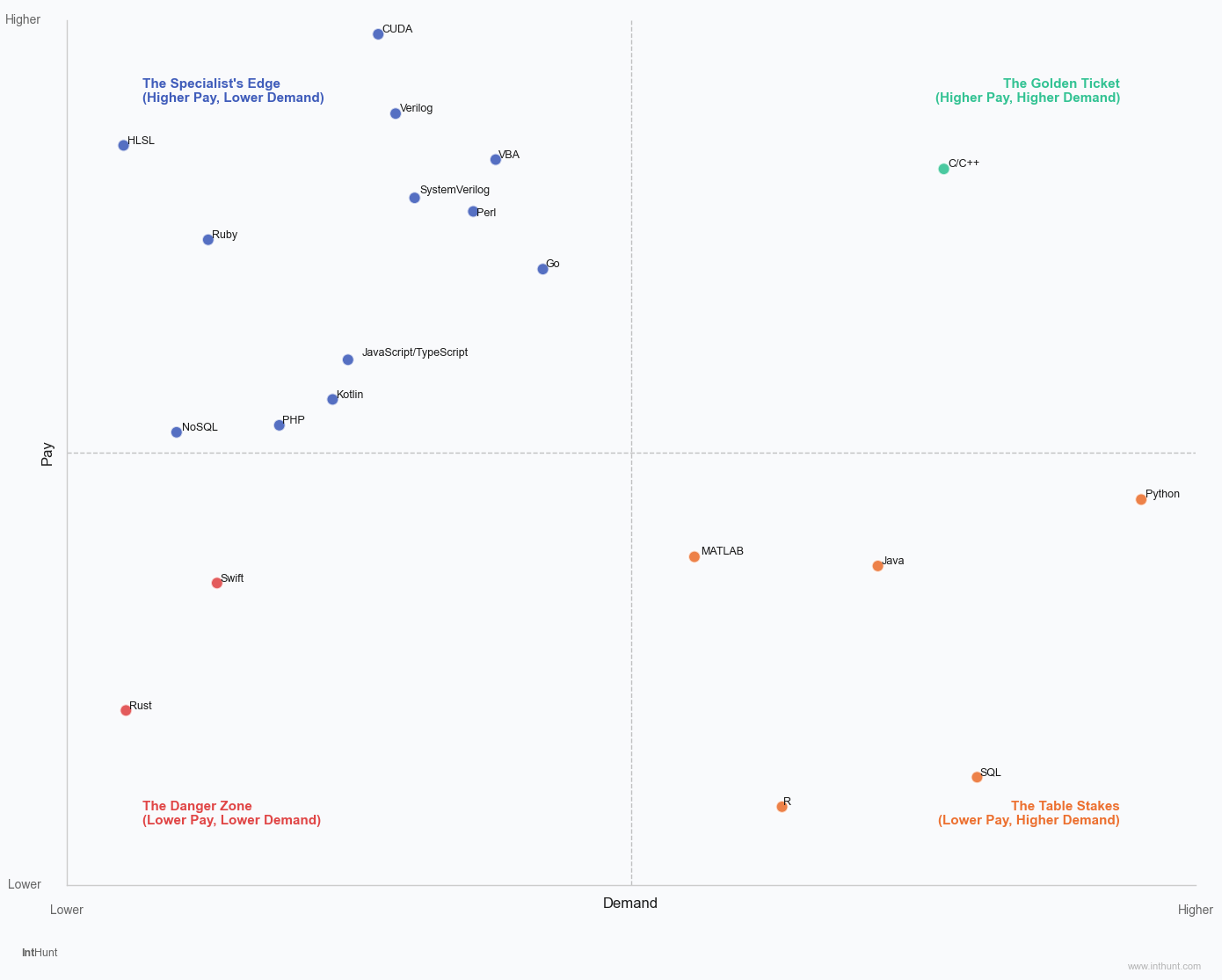
At IntHunt, we don't rely on hype. We rely on hard data. We analyzed over 7,000 internship listings to determine exactly what employers are paying for right now. We mapped the relationship between Demand (volume of open roles) and Pay (hourly rate) to see where the real leverage lies.
The Quadrant Analysis: Where Do You Fit?
We plotted the most common languages on a matrix of Pay vs. Demand. The results contradict almost every generic "Top 10 Languages" list you’ll find on Google.
1. The Golden Ticket: C/C++
Status: High Pay, High Demand
If you want the highest probability of landing a high-paying role, C/C++ is the statistically dominant choice. The highest-paying internships in 2026—specifically in High-Frequency Trading (HFT), quantitative finance, and systems engineering—run on C++. The data shows it sits alone in the top-right quadrant: companies need it desperately, and they are willing to pay a premium for it.
The Strategy: If you are a CS major, stop ignoring your systems coursework. Proficiency in memory management and pointers is currently your most liquid asset.
2. The Specialist’s Edge: Hardware & Legacy
Status: High Pay, Lower Demand
This is the contrarian play. These languages have fewer total openings, but the "Supply vs. Demand" curve is broken in your favor. Because so few students learn these languages, companies are forced to pay massive premiums to attract talent.
- The Hardware Stack: As seen in the top-left quadrant, CUDA, Verilog, SystemVerilog, and HLSL offer the "Specialist's Edge". With the explosion of AI hardware and GPU computing, interns who understand the hardware-software interface are commanding the highest rates in our dataset.
- The "Boring" Stack: Surprisingly, VBA and Perl are also sitting in the high-pay bracket. Why? Legacy codebases in massive financial and industrial firms need maintenance, and Gen Z isn't learning Perl. Scarcity equals value.
3. The Table Stakes: Python, SQL, Java
Status: Lower Pay, Highest Demand
This is the "Safety Zone," but also the "Crowded Zone." Python, SQL, and Java have the highest demand on the X-axis. However, because they are standard curriculum in almost every university, the supply of interns is massive.
This drives the price down. In 2026, knowing Python doesn't make you a specialist; it just makes you literate. It is the new Excel. You likely need these on your resume to get past the Applicant Tracking System (ATS), but do not expect them to drive a wage premium on their own.
4. The Danger Zone: Web & "Hype" Languages
Status: Lower Pay, Low Demand
Languages that dominate online discourse—Rust, Swift, Kotlin, and JavaScript/TypeScript—are currently landing in the bottom-left quadrant for internships. While these are excellent languages for senior full-time engineers, the internship market for them is softer.
Major-Specific Reality Check: What Should You Learn?
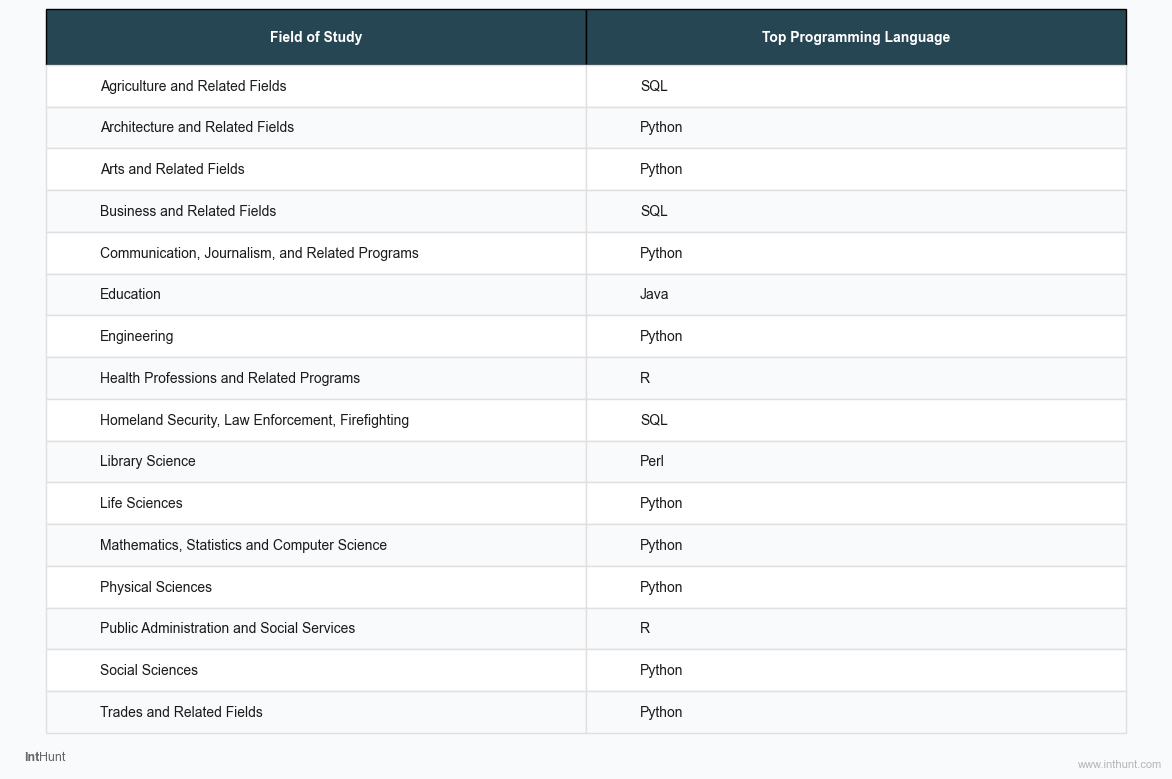
If you aren't a Computer Science major, you don't need to learn C++. You need to learn the language that dominates your specific industry. We analyzed the most requested language by Field of Study.
The "SQL" Sector
If you are in Business, Homeland Security, or Agriculture, drop the Python tutorials and learn SQL.
Why? In these fields, data is structured in databases. Employers need interns who can query that data to generate reports and insights. It is the number one technical skill requested for Business and Finance-related majors.
The "Python" Sector
Python is the undisputed king for Engineering, Life Sciences, Physical Sciences, Arts, and Social Sciences.
Why? In these fields, Python is used for data analysis, modeling, and automation. It has replaced MATLAB and R in many Engineering and Architecture workflows.
The "R" Sector
If you are in Health Professions or Public Administration, focus on R.
Why? These fields rely heavily on statistical analysis for clinical trials, public policy research, and epidemiology. R remains the standard for rigorous statistical work in these domains.
The Niche Outliers
- Education Majors: The top language is Java.
- Library Science: The top language is Perl. (Yes, really. Library metadata systems run deep on legacy Perl scripts).
The Verdict: Stop Guessing, Start Filtering
The days of "learn to code and you'll be rich" are over. The market has matured. To maximize your value as an intern in 2026, you need to align your skills with market scarcity.
- Want the big money? Go low-level (C++, CUDA, Verilog).
- Want the most options? Master the Table Stakes (Python, SQL).
- Want to stand out? Don't be a Business major who knows "a little Java." Be a Business major who is a wizard at SQL.
At IntHunt, we believe in transparency. Exposure doesn't pay rent, and guessing doesn't get you hired.
We excluded internships where programming language requirements were unclear. This snapshot reflects analysis of 7,000+ internships in the IntHunt database as of January 6th, 2026. Please note that the axis scales and exact positions of points (programming languages) in Figure 1 have been log- and rank-transformed to balance accuracy with readability and interpretability. This article is not kept up to date with new data. To request the underlying aggregated data, email contact@inthunt.com.